Our history, purpose and mission, core values and the team behind ISTO
Our History
Founded in 2001, the International Standardized Testing Organization (ISTO) was established in Switzerland to provide independent, worldwide tests of understanding of the ISO 9000:2000 series.
Our logo from 2001 to 2025
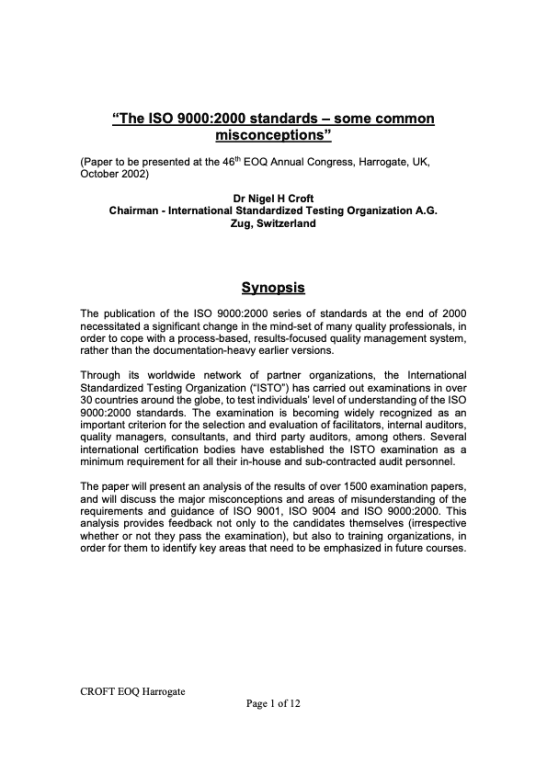
"The ISO 9000:2000 standards – some common misconceptions"
2002 EOQ presentation by Dr. Nigel Croft
The paper, presented by Dr. Nigel Croft, Chairman of ISTO in 2002, discusses common misconceptions about the ISO 9000:2000 standards, based on analysis of over 1500 examination papers from the ISTO Test of Understanding of the ISO 9000:2000 standards.
The ISO 9000:2000 standards represented a significant shift from the 1994 versions, moving towards a more process-oriented, results-focused quality management system, which required a change in mindset for many quality professionals. The ISTO Test of Understanding was developed to provide a means for individuals to demonstrate their understanding of the concepts, terminology, and requirements of the ISO 9000:2000 standards.
The two-decade-old paper establishing the ISTO Test as a recognised assessment of competence in ISO management system standards remains ever relevant today.
The paper is available for download:
Our Purpose and Mission
With an ever-increasing number of self-proclaimed "experts" on ISO management system standards, and the vast number of training courses offered around the world with varying syllabi and standards of presentation, the need has become apparent for internationally-recognised qualifications to effectively demonstrate an individual's understanding and ability of implementation.
Since its establishment in 2001, ISTO has been offering a comprehensive range of qualifications to international standards and other competence areas to address the needs of user communities and professionals from different disciplines.
Apart from the certificate of achievement, candidates will be presented with an analysis report on their scores in the A C C U R A T E domains, and the ranking relative to other candidates.
Our Purpose
To enable businesses and individuals to elevate their performance by offering a globally recognized benchmark test in understanding of ISO management system standards
Our Mission
To provide globally recognised, independent and impartial qualifications in international standards or other competence areas, cost effectively to individuals around the globe.
What does an ISTO qualification mean
An opportunity for professionals to demonstrate their knowledge and skills
A platform to acquire qualifications in the understanding and implementation of the standards and other competence areas
Satisfies the often-required criteria in the selection of staff members
A basis for the responsible dissemination of knowledge by training organizations
A validating tool on continuing professional development
Our History
Founded in 2001, the International Standardized Testing Organization (ISTO) was established in Switzerland to provide independent, worldwide tests of understanding of the ISO 9000:2000 series.
Our logo from 2001 to 2025
"The ISO 9000:2000 standards – some common misconceptions"
2002 EOQ presentation by Dr. Nigel Croft
The paper, presented by Dr. Nigel Croft, Chairman of ISTO in 2002, discusses common misconceptions about the ISO 9000:2000 standards, based on analysis of over 1500 examination papers from the ISTO Test of Understanding of the ISO 9000:2000 standards.
The ISO 9000:2000 standards represented a significant shift from the 1994 versions, moving towards a more process-oriented, results-focused quality management system, which required a change in mindset for many quality professionals. The ISTO Test of Understanding was developed to provide a means for individuals to demonstrate their understanding of the concepts, terminology, and requirements of the ISO 9000:2000 standards.
The two-decade-old paper establishing the ISTO Test as a recognised assessment of competence in ISO management system standards remains ever relevant today.
The paper is available for download:
Our Purpose and Mission
With an ever-increasing number of self-proclaimed "experts" on ISO management system standards, and the vast number of training courses offered around the world with varying syllabi and standards of presentation, the need has become apparent for internationally-recognised qualifications to effectively demonstrate an individual's understanding and ability of implementation.
Since its establishment in 2001, ISTO has been offering a comprehensive range of qualifications to international standards and other competence areas to address the needs of user communities and professionals from different disciplines.
Apart from the certificate of achievement, candidates will be presented with an analysis report on their scores in the A C C U R A T E domains, and the ranking relative to other candidates.
Our Purpose
To enable businesses and individuals to elevate their performance by offering a globally recognized benchmark test in understanding of ISO management system standards
Our Mission
To provide globally recognised, independent and impartial qualifications in international standards or other competence areas, cost effectively to individuals around the globe.
What does an ISTO qualification mean
An opportunity for professionals to demonstrate their knowledge and skills
A platform to acquire qualifications in the understanding and implementation of the standards and other competence areas
Satisfies the often-required criteria in the selection of staff members
A basis for the responsible dissemination of knowledge by training organizations
A validating tool on continuing professional development
Our History
Founded in 2001, the International Standardized Testing Organization (ISTO) was established in Switzerland to provide independent, worldwide tests of understanding of the ISO 9000:2000 series.
Our logo from 2001 to 2025
"The ISO 9000:2000 standards – some common misconceptions"
2002 EOQ presentation by Dr. Nigel Croft
The paper, presented by Dr. Nigel Croft, Chairman of ISTO in 2002, discusses common misconceptions about the ISO 9000:2000 standards, based on analysis of over 1500 examination papers from the ISTO Test of Understanding of the ISO 9000:2000 standards.
The ISO 9000:2000 standards represented a significant shift from the 1994 versions, moving towards a more process-oriented, results-focused quality management system, which required a change in mindset for many quality professionals. The ISTO Test of Understanding was developed to provide a means for individuals to demonstrate their understanding of the concepts, terminology, and requirements of the ISO 9000:2000 standards.
The two-decade-old paper establishing the ISTO Test as a recognised assessment of competence in ISO management system standards remains ever relevant today.
The paper is available for download:
Our Purpose and Mission
With an ever-increasing number of self-proclaimed "experts" on ISO management system standards, and the vast number of training courses offered around the world with varying syllabi and standards of presentation, the need has become apparent for internationally-recognised qualifications to effectively demonstrate an individual's understanding and ability of implementation.
Since its establishment in 2001, ISTO has been offering a comprehensive range of qualifications to international standards and other competence areas to address the needs of user communities and professionals from different disciplines.
Apart from the certificate of achievement, candidates will be presented with an analysis report on their scores in the A C C U R A T E domains, and the ranking relative to other candidates.
Our Purpose
To enable businesses and individuals to elevate their performance by offering a globally recognized benchmark test in understanding of ISO management system standards
Our Mission
To provide globally recognised, independent and impartial qualifications in international standards or other competence areas, cost effectively to individuals around the globe.
What does an ISTO qualification mean
An opportunity for professionals to demonstrate their knowledge and skills
A platform to acquire qualifications in the understanding and implementation of the standards and other competence areas
Satisfies the often-required criteria in the selection of staff members
A basis for the responsible dissemination of knowledge by training organizations
A validating tool on continuing professional development
Our Five Core Values
Focus on Knowledge
We will not differentiate between candidates based on how learning was acquired but will focus solely on the level of knowledge possessed.
Focus on Knowledge
We will not differentiate between candidates based on how learning was acquired but will focus solely on the level of knowledge possessed.
Focus on Knowledge
We will not differentiate between candidates based on how learning was acquired but will focus solely on the level of knowledge possessed.
Confidentiality
Our operation and our global partners are committed to protecting learner confidentiality at all stage of the test process.
Confidentiality
Our operation and our global partners are committed to protecting learner confidentiality at all stage of the test process.
Confidentiality
Our operation and our global partners are committed to protecting learner confidentiality at all stage of the test process.
Technical Integrity
Our tests are technically demanding, but at the same time unambiguous, impartial and fair.
Technical Integrity
Our tests are technically demanding, but at the same time unambiguous, impartial and fair.
Technical Integrity
Our tests are technically demanding, but at the same time unambiguous, impartial and fair.
Transparency
Our tests will be administered and marked fairly and objectively.
Transparency
Our tests will be administered and marked fairly and objectively.
Transparency
Our tests will be administered and marked fairly and objectively.
Innovative
We will continuously look at ways, in particular technology, to improve the efficiency and effectiveness of our services and our processes.
Innovative
We will continuously look at ways, in particular technology, to improve the efficiency and effectiveness of our services and our processes.
Innovative
We will continuously look at ways, in particular technology, to improve the efficiency and effectiveness of our services and our processes.
Governance and Team
The Technical Advisory Board (TAB) advises the executive team on policy as well as technical matters, and to safeguard the impartiality of ISTO test process in line with ISTO strategy and the ISTO’s organizational priorities.
TAB members are generally members of ISO technical committees, or top management personnel in national standards bodies, trade associations, certification bodies, advisory firms and IRCA Approved Training Partners.
Technical Advisory Board (TAB)

Ms. Joana dos Guimarães Sá
Chairlady of Advisory Board
Joana dos Guimarães Sá is an auditor and senior advisor on sustainability, management systems and certification, having developed its professional activity in the certification business operations and product development and previously in wood technology and Forest Inventory.
Her CV is available for download
Ms. Joana dos Guimarães Sá
Chairlady of Advisory Board
Joana dos Guimarães Sá is an auditor and senior advisor on sustainability, management systems and certification, having developed its professional activity in the certification business operations and product development and previously in wood technology and Forest Inventory.
Her CV is available for download
Ms. Joana dos Guimarães Sá
Chairlady of Advisory Board
Joana dos Guimarães Sá is an auditor and senior advisor on sustainability, management systems and certification, having developed its professional activity in the certification business operations and product development and previously in wood technology and Forest Inventory.
Her CV is available for download

Mr. Richard Green
Advisory Board Member
Mr. Green is the Founder and Managing Director of Kingsford Consultancy Services Limited based in the UK. He is also a serving member of a number of high profile British Standards Institute and ISO Committees.
His CV is available for download
Mr. Richard Green
Advisory Board Member
Mr. Green is the Founder and Managing Director of Kingsford Consultancy Services Limited based in the UK. He is also a serving member of a number of high profile British Standards Institute and ISO Committees.
His CV is available for download
Mr. Richard Green
Advisory Board Member
Mr. Green is the Founder and Managing Director of Kingsford Consultancy Services Limited based in the UK. He is also a serving member of a number of high profile British Standards Institute and ISO Committees.
His CV is available for download

Mr. Gerardo Espinosa
Advisory Board Member
Mr. Espinosa is the Director of INLAC, the latin-american institute for quality since 2001. He has been the INLAC delegate in ISO/TC 176 since 2000, and is also a member of WG24 for the development of ISO 9001:2015.
His CV is available for download
Mr. Gerardo Espinosa
Advisory Board Member
Mr. Espinosa is the Director of INLAC, the latin-american institute for quality since 2001. He has been the INLAC delegate in ISO/TC 176 since 2000, and is also a member of WG24 for the development of ISO 9001:2015.
His CV is available for download
Mr. Gerardo Espinosa
Advisory Board Member
Mr. Espinosa is the Director of INLAC, the latin-american institute for quality since 2001. He has been the INLAC delegate in ISO/TC 176 since 2000, and is also a member of WG24 for the development of ISO 9001:2015.
His CV is available for download

Mr. Byung Yong Lee
Advisory Board Member
Mr. Lee has served as the Vice President of the Korean Foundation for Quality, the President of the Korea Verification Association of Greenhouse Gas, and Director General of Social Responsibility & Management Quality Institute.
His CV is available for download
Mr. Byung Yong Lee
Advisory Board Member
Mr. Lee has served as the Vice President of the Korean Foundation for Quality, the President of the Korea Verification Association of Greenhouse Gas, and Director General of Social Responsibility & Management Quality Institute.
His CV is available for download
Mr. Byung Yong Lee
Advisory Board Member
Mr. Lee has served as the Vice President of the Korean Foundation for Quality, the President of the Korea Verification Association of Greenhouse Gas, and Director General of Social Responsibility & Management Quality Institute.
His CV is available for download

Mr. Howie Ng
Chief Executive Officer
Mr. Ng is an international adviser, lead auditor training course developer and tutor in ISO management systems. Mr. Ng has delivered IRCA certified lead auditor and other courses in over 30 countries.
His CV is available for download
Mr. Howie Ng
Chief Executive Officer
Mr. Ng is an international adviser, lead auditor training course developer and tutor in ISO management systems. Mr. Ng has delivered IRCA certified lead auditor and other courses in over 30 countries.
His CV is available for download
Mr. Howie Ng
Chief Executive Officer
Mr. Ng is an international adviser, lead auditor training course developer and tutor in ISO management systems. Mr. Ng has delivered IRCA certified lead auditor and other courses in over 30 countries.
His CV is available for download
Examination Panel
The purpose of the Examination Panel is to be responsible for all matters related to the test process, including test scheme development, test question writing and improvement, test delivery, test marking and reporting. The Chairman of the Examination Panel is a de facto member of the Technical Advisory Board.
Test questions are developed through a multi-tiered drafting process, and are submitted to recognised experts for validation, prior to inclusion into the question pool. The pool of test questions, together with the suggested answers, is reviewed by an Examination Panel task force established specifically for the purpose.
The technical performance of each particular question is monitored and evaluated on an on-going basis and questions may be retired as needed.
The Examination Panel handles appeals related to test results.
Chairman: Mr. Richard Green.
The CEO is an observer to the Examination Panel.
Operations
The Operations team is responsible for overall customer care, the integrity of the delivery system, and the development and support of worldwide partners.
Led by the CEO, the ISTO Support Centre is responsible for the day-to-day ISTO operation. The ISTO IT infrastructure is outsourced to a cloud service provider.
The ISTO CEO acts as secretary to the Technical Advisory Board.
Operations
The Operations team is responsible for overall customer care, the integrity of the delivery system, and the development and support of worldwide partners.
Led by the CEO, the ISTO Support Centre is responsible for the day-to-day ISTO operation. The ISTO IT infrastructure is outsourced to a cloud service provider.
The ISTO CEO acts as secretary to the Technical Advisory Board.